System Blueprint
This page is a full component-level blueprint of the SGEMM optimization system. It maps every major component, the data flows between them, and the design decisions that constrain those flows.
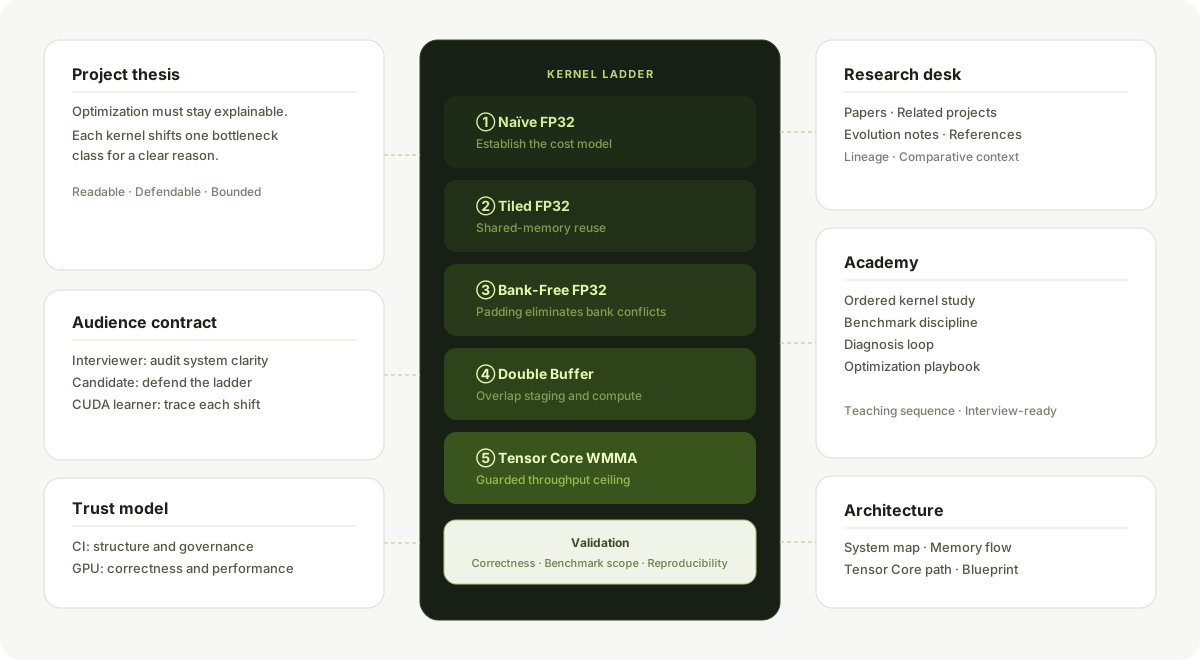
The blueprint maps every component that has an explicit architectural reason to exist. Components without a reason are either not here or marked as open questions.
Component inventory
| Component | Role | Constraints |
|---|---|---|
src/main.cu | Parses arguments, delegates to CliParser and BenchmarkRunner | Must keep one runtime-controlled entry path |
src/cli_parser.cuh | Maps CLI flags to benchmark/verification modes | Shape labels and mode switches stay centralized |
src/benchmark_runner.cuh | Routes each configured run through benchmarking and reporting | Shared host orchestration keeps cross-kernel comparisons consistent |
src/kernels/naive_sgemm.cuh | Baseline FP32, one thread per output element | Establishes the cost model; no shared memory |
src/kernels/tiled_sgemm.cuh | Tiled FP32 with shared-memory staging | Tile size is a compile-time template parameter |
src/kernels/bank_conflict_free_sgemm.cuh | Tiled FP32 with padding to eliminate bank conflicts | Padding is the only structural difference from tiled |
src/kernels/double_buffer_sgemm.cuh | Overlapped staging and compute using double buffering | Requires two staging buffers in shared memory |
src/kernels/tensor_core_sgemm.cuh | WMMA-based computation for aligned Tensor Core shapes | Guarded by device capability and shape divisibility |
src/kernels/tensor_core_fallback.cuh | Safe mixed-precision entry and fallback logic | Must preserve FP32 correctness on unsupported shapes |
src/utils/cuda_utils.cuh | CUDA error macros, RAII device memory, device metadata | Uses CUDA_CHECK / CUBLAS_CHECK; no silent failure path |
src/utils/verify.cuh | cuBLAS-backed oracle verification and tolerance policy | Reference is computed against cuBLAS on the active GPU |
tests/test_sgemm.cu | cuBLAS-backed oracle correctness suite | Runs only on GPU; not included in hosted CI |
| Docs site | Narrative layer — architecture, academy, validation, research | VitePress with bilingual routes; no runtime GPU dependency |
Data flow: host to device
Host allocates A, B, C (row-major, FP32)
  │
  ▼
cudaMemcpy H→D
  │
  ▼
Kernel launch (grid, block, shared-memory budget)
  ├─ Naive path: direct global reads per thread
  ├─ Tiled path: cooperative staging into shared tile
  ├─ Bank-free path: padded tile staging
  ├─ Double-buffer path: async prefetch of next tile
  └─ Tensor Core path: FP32→FP16 conversion + WMMA fragment accumulation
  │
  ▼
cudaMemcpy D→H
  │
  ▼
Correctness check against cuBLAS oracle (local GPU only)
Design decisions and their architectural consequences
RAII error handling
All CUDA API calls and kernel launches are wrapped in CUDA_CHECK, and cuBLAS calls are wrapped in CUBLAS_CHECK. This ensures that any failure path immediately terminates with a traceable error rather than silently propagating incorrect results through the pipeline.
Consequence: Test code cannot accidentally swallow an error and then compare incorrect output against the cuBLAS oracle, which would make a failing kernel appear to pass.
Runtime kernel selection
The entry point selects the kernel variant at runtime from a command-line argument, rather than compiling multiple executables.
Consequence: Benchmark comparisons between variants use the same binary and the same host code path, making the comparison cleaner and eliminating build-flag confounds.
Template tile sizes
Tile dimensions are compile-time template parameters, not runtime constants.
Consequence: The shared-memory layout is known at compile time, enabling the compiler to generate efficient addressing and avoiding dynamic shared-memory allocation overhead. The tradeoff is that only the compiled tile sizes can be benchmarked without a rebuild.
Tensor Core as guarded optional path
The Tensor Core variant checks device capability and shape divisibility before committing to WMMA computation, and falls back to the FP32 tiled path otherwise.
Consequence: The system is safe to run on non-Tensor-Core hardware, and benchmark results from such hardware are labeled as FP32 results, not mixed-precision results.
Validation boundary in the blueprint
The blueprint explicitly separates compile-time-verifiable invariants from runtime-verifiable invariants:
| Invariant class | Verifiable where |
|---|---|
| File structure, docs, and workflow health | Hosted CI |
| CUDA compilation | Hosted CI |
| CUDA runtime execution | Local GPU-capable machine |
| Correctness under cuBLAS oracle | Local GPU run |
| Benchmark numbers and speedup ratios | Local GPU run with named hardware |
Related pages
- Architecture Overview — system map and design rationale
- Kernel Ladder — optimization order and bottleneck shifts
- Tensor Core Path — Tensor Core constraints and fallback behavior
- Correctness Policy — oracle definition and tolerance thresholds
- Performance Model — quantitative cost model